Best Budget Planners to Organize Your Finances Effectively
Managing personal finances can feel overwhelming without the right tools. Whether you are tracking daily expenses, planning for bills, or setting savings goals, a well-designed budget planner can make the process simpler and more organized. Physical budget notebooks provide a hands-on approach that encourages mindful spending and consistent record-keeping, helping users gain control over their money.
In this guide, we focus on highly-rated, user-approved budget planners that are undated, flexible, and suitable for year-round financial management. These planners offer dedicated sections for monthly expenses, bills, savings, and financial goals. Many also include visual aids, colorful tabs, or aesthetic designs that make budgeting a more engaging and enjoyable habit.
The planners selected in this guide are not only popular on Amazon but have received thousands of positive reviews, reflecting real-life usability, durability, and effectiveness. They are available in convenient A5 sizes, balancing portability with sufficient writing space, and are suitable for both beginners and experienced budget trackers. By incorporating these planners into your routine, you can build better financial habits and maintain a clear overview of your spending and saving patterns.
Criteria for Choosing These Budget Planners
-
User Ratings and Reviews: Only planners with consistently high ratings and substantial numbers of reviews were considered. This ensures that the products have proven reliability and widespread satisfaction.
-
Functionality: Each planner includes comprehensive sections for expenses, income, savings, and bills. Features like undated layouts and monthly tabs increase usability and flexibility.
-
Design and Usability: Planners were evaluated for readability, writing space, portability, and overall user experience. Aesthetics, such as colorful tabs or visually appealing covers, were also considered for motivation and engagement.
-
Durability and Build Quality: Physical quality of the planner—binding, cover material, and paper thickness—was considered, as it affects long-term usability.
-
Flexibility: Undated and portable formats were prioritized to allow users to start anytime and carry their planner conveniently, supporting consistent financial tracking.
Overviews
Monthly Budget Planner & Finance Tracker Notebook


A comprehensive undated finance planner designed to help users track income, expenses, bills, savings goals, and debt throughout the year. Its undated format lets you start anytime, and the ample spaces encourage consistent financial tracking and planning.
Pros
-
User-friendly and adaptable: Large sections for monthly spending, bill tracking, and financial goals make it easy for users to structure and review their budget at a glance.
-
High volume of positive feedback: Thousands of customers give it strong overall ratings (around 4.5★), indicating broad satisfaction with its effectiveness for day-to-day budgeting.
-
Physical prompts encourage discipline: Writing out numbers manually can help reinforce habits and awareness of spending patterns.
-
Includes motivational elements: Some versions come with stickers and review sections that make tracking more engaging.
Cons
-
Physical format limits automation: Unlike a true app, users must manually input all data — there’s no syncing or auto-categorization.
-
Writing space can fill quickly: Some reviewers note that dedicated space may run out mid-month if tracking daily expenses in detail.
-
Binding can interfere with writing: Some customers find it tricky to write near the spine depending on the planner style.
SUNEE Budget Planner – Monthly Budget Book with Expense Tracker

The SUNEE Budget Planner is an undated, 12-month financial organizer designed to help users manage income, expenses, bills, and savings goals in a structured and consistent way. Sized in A5 format, it balances portability with sufficient writing space, making it suitable for daily use at home or on the go. The planner features clearly labeled sections, monthly expense breakdowns, and colorful tabs that allow for quick navigation throughout the year. Its minimalist black design and practical layout make it appealing to users who prefer a straightforward, distraction-free approach to personal budgeting.
Pros
-
Clear and organized layout: Users frequently highlight the logical structure of the planner, noting that income, fixed bills, variable expenses, and savings goals are separated in a way that makes monthly reviews easy and intuitive.
-
Undated flexibility: The undated format allows users to start at any time of the year without wasting pages, which many reviewers appreciate for long-term consistency.
-
Good balance of size and usability: The A5 size is often praised for being compact enough to carry while still offering enough space to write daily or weekly expenses comfortably.
-
Durable and well-finished design: Many reviews mention the solid cover, quality paper, and sturdy binding, which help the planner withstand regular handling over months of use.
-
Helpful visual tabs: Colorful monthly tabs improve navigation and make it faster to locate specific months or sections, especially for users who review their budget frequently.
Cons
-
Manual tracking required: As a paper-based system, all calculations and entries must be done by hand, which some users find time-consuming compared to digital budgeting apps.
-
Limited space for high-volume spending: Users with many daily transactions sometimes note that the expense sections can fill up quickly, requiring more concise entries.
-
No built-in financial guidance: The planner focuses on tracking rather than teaching, so beginners looking for step-by-step budgeting instructions may need external guidance.
-
Spine and page flatness: A small number of users report that the planner does not always lie completely flat, which can make writing near the inner margins slightly inconvenient.
Smart Planner Budget Book

A budget and finance organizer that’s compact yet functional, allowing users to track income, expenses, debt, and savings goals in one place.
Pros
-
Affordable and simple: Highly accessible for beginners looking for straightforward budgeting guidance.
-
Portable size: Easy to carry and reference on the go.
-
Helpful pocket section: Space for holding receipts or small notes.
Cons
-
Readability concerns: A few reviewers mention that print size or layout can be hard to read.
-
Not as robust as larger planners: Limited space for detailed long-term financial planning.
Budget Planner Book – Undated Monthly Budget & Expense Tracker Notebook

The Budget Planner Book is an undated, 12-month finance organizer designed to help users take control of their personal finances by tracking income, expenses, savings goals, and bills all in one place. Its A5 size makes it versatile for home use, travel, or daily carry, and the undated format lets users begin budgeting at any time without wasted pages. With dedicated sections for monthly overviews, expense breakdowns, and goal setting, this notebook appeals to individuals seeking a structured yet flexible way to monitor and improve their money management habits.
Pros
-
Flexible undated layout: Users can start using the planner at any time of year, which many reviewers find practical for ongoing budgeting without seasonal constraints.
-
Comprehensive organization: Sections for fixed expenses, variable spending, savings targets, and debt tracking help users see the full picture of their financial habits in one place.
-
Portable and user-friendly: The A5 size is frequently praised for being easy to carry around and comfortable to write in, making daily updates more convenient.
-
Encourages financial accountability: Many users report that physically writing down expenses increases their awareness of spending patterns and helps improve savings behavior.
-
Simple design: The clean, no-nonsense layout appeals to users who want straightforward tracking without unnecessary complexity.
Cons
-
Manual entry only: Because it’s a physical notebook, all tracking, categorization, and summations must be done by hand, which can be time-intensive compared to digital tools.
-
Limited space for detailed entries: Some reviewers note that the allotted writing areas can be tight for users with many daily transactions or complex budgeting needs.
-
No automated calculations: Users must calculate totals and differences manually, which may be cumbersome for those accustomed to app-based budgeting with auto-math features.
-
Basic guidance: The planner focuses on structure rather than financial education, so users looking for budgeting strategies or best-practice tips may need supplemental resources.
Aesthetic Budget Planner – Monthly Finance Planner with Expense Tracker
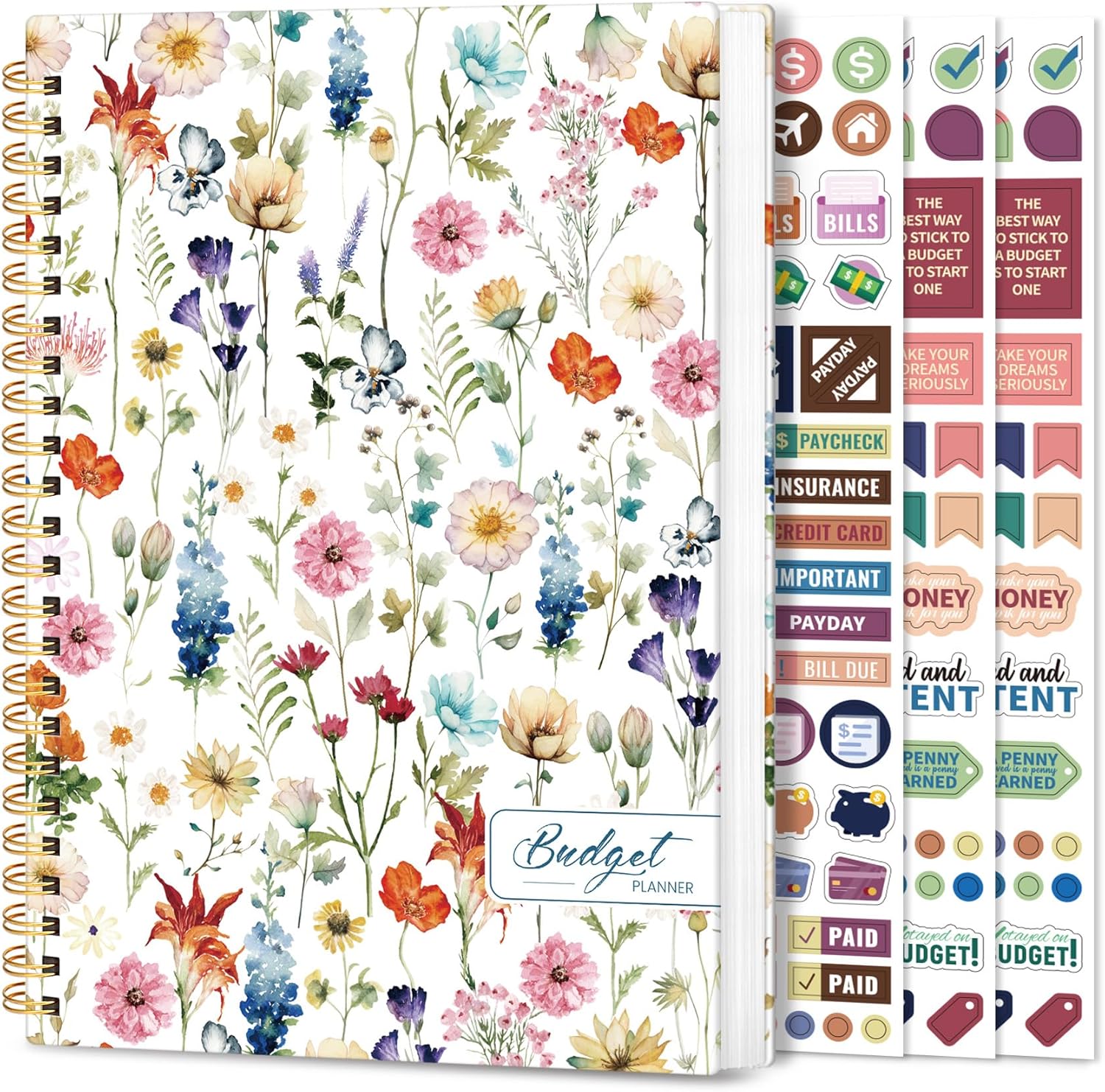
The Aesthetic Budget Planner is an undated monthly finance organizer designed to help users manage bills, track expenses, and plan savings in a visually appealing format. Featuring a colorful wildflower pattern on the cover, this budget notebook blends functional financial tracking with an attractive design that many users appreciate. Its undated layout allows flexibility to begin at any point in the year, and the included sections encourage users to consistently monitor spending and budget goals.
Pros
-
Visually appealing design: The colorful wildflower cover and thoughtful interior layout make the planner enjoyable to use, which many reviewers say helps motivate consistent budgeting.
-
Undated flexibility: Users can start budgeting at any time without wasted pages, making it useful for beginners or those resuming financial tracking.
-
Comprehensive expense tracking: The planner includes sections for income, bills, savings goals, and detailed monthly expenses, helping users see their financial picture at a glance.
-
Encourages habit building: Many reviewers note that writing down expenses and tracking categories regularly increases spending awareness and supports better financial habits.
-
Good size for portability: The A5 format strikes a balance between having enough space to write and being easy to carry in a bag or planner.
Cons
-
Manual entry only: As a physical notebook, all tracking must be written by hand, which some users find slower and less convenient compared to digital tools with automatic calculations.
-
Space limitations: A few reviewers mention that the writing areas for detailed daily entries can feel small if tracking numerous transactions.
-
No built-in math functions: Users must calculate totals manually, which can be tedious without auxiliary tools like a calculator.
-
Basic guidance: The planner focuses on structure over instructions, so those new to budgeting may need additional resources for financial planning strategies.