Top-Rated 3D Printers on Amazon: Popular and Proven Choices
3D printing has become increasingly accessible, with modern desktop printers offering reliable performance, improved print quality, and user-friendly operation at a wide range of price points. As a result, many consumers now rely on verified user feedback from retail platforms and online communities when selecting a printer that balances quality, usability, and long-term value.
This guide focuses on some of the most popular and top-rated 3D printers currently available on Amazon. The selected models consistently receive high ratings, strong sales volumes, and extensive user engagement, indicating broad satisfaction across different experience levels. Together, they represent a balanced mix of filament and resin printers suitable for beginners, hobbyists, and more advanced users.
Rather than emphasizing technical specifications alone, this guide prioritizes real-world performance and ownership experience. By examining printers that have proven themselves through sustained popularity and positive feedback, the aim is to highlight dependable options that meet the expectations of a wide audience.
Selection Criteria
To identify the most reliable and broadly recommended 3D printers on Amazon, the following five criteria were applied:
-
Amazon Availability and Popularity Each printer is actively sold on Amazon.com and consistently appears in best-seller lists or high-visibility product rankings, reflecting ongoing demand and popularity among buyers.
-
High Review Quantity and Average Rating Only models with a large number of user reviews and a strong average star rating were considered, ensuring that overall impressions are based on substantial user feedback rather than limited responses.
-
Positive Real-World User Feedback Beyond numerical ratings, community and reviewer commentary was evaluated for themes like reliability, ease of use, and sustained performance over time. Printers with frequent reports of consistent issues were excluded.
-
Balanced Usability Across Skill Levels This guide includes printers that appeal not only to experienced makers but also to beginners and intermediate users. Factors like assembly difficulty, calibration requirements, and user support influenced selections.
-
Value Relative to Features Each included model delivers strong performance or unique capabilities for its price range—whether through automated features, build volume, material versatility, or print quality—ensuring meaningful value for typical consumer needs.
Overviews
FLASHFORGE Adventurer 5M 3D Printer


The FLASHFORGE Adventurer 5M is a fully-featured FDM 3D printer that frequently tops Amazon’s Best Sellers list for 3D printers thanks to its ease of use, reliable high-speed printing, and auto-leveling functionality. It includes a CoreXY frame, detachable nozzle, and a build volume suitable for a wide range of home and hobbyist projects while maintaining ease of setup and operation.
Pros
-
Ready-to-use setup: Arrives mostly assembled with one-click auto leveling and plug-and-play operation, which reviewers say dramatically reduces the initial setup time and frustration for beginners.
-
High print speeds: Capable of speeds up to 600 mm/s depending on model configuration, which many users report delivers good through-put for everyday prints.
-
Versatile filament support: Works well with PLA, ABS, and PETG, accommodating a broad range of printing projects from functional prototypes to decorative items.
Cons
-
Touchscreen limitations: The interface screen is considered by some reviewers as small and occasionally unresponsive compared with higher-end competitors.
-
Build volume constraints: While sufficient for most hobby projects, the size may be limiting for larger items or industrial-scale prototypes.
-
Occasional quality variability: Some users note minor quality control differences between units, which is common at this price point.
ELEGOO Neptune 3 Pro FDM 3D Printer

The ELEGOO Neptune 3 Pro is a popular mid-range FDM 3D printer on Amazon that balances ease of use with robust printing performance. It features auto bed leveling, a dual-gear direct extruder, and a large print area that suits hobbyists and semi-experienced makers alike.
Pros
-
Auto bed leveling: Reduces manual calibration effort and improves first-layer reliability, a highly valued feature in user reviews.
-
Dual-gear extruder: Provides consistent filament feeding, which users often highlight as leading to fewer clogs and smoother prints.
-
Large build volume: Larger than entry-level printers, enabling more ambitious projects without moving to a higher price bracket.
Cons
-
Competitive quality at price: In its price range, some hobby users feel other printers may offer slightly better print speed or feature sets.
-
Assembly and setup: While auto leveling helps, assembly and part-out-of-box calibration still require patience for absolute beginners.
-
Limited advanced features: Lacks certain high-end options (e.g., filament flow control) found in premium machines.
Creality Ender 3 V3 SE 3D Printer
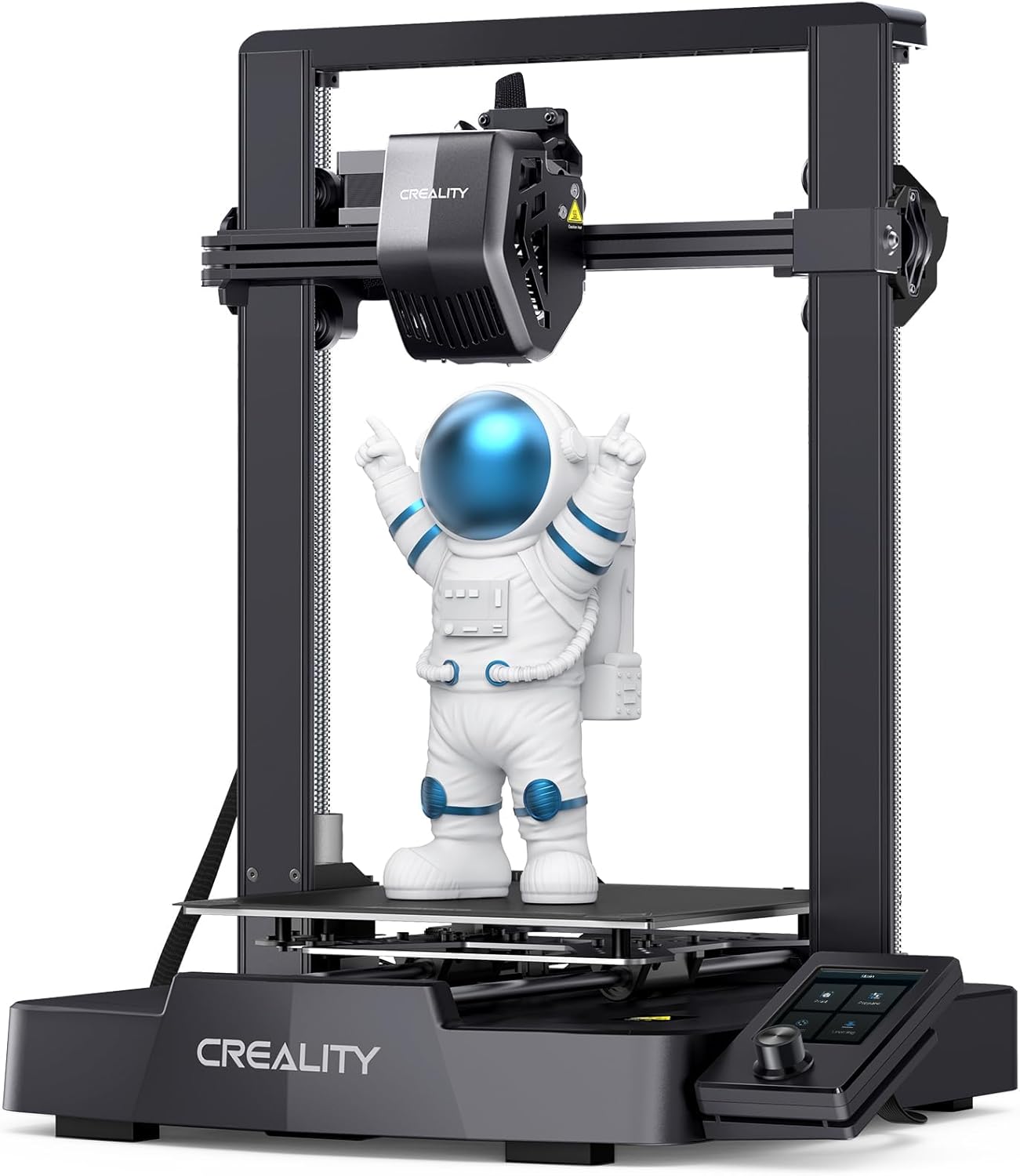
The Creality Ender 3 V3 SE is part of the famed Ender series—one of the most frequently sold and discussed printer lines on Amazon. It combines a compact design with auto leveling, dual Z-axis stability, and good print quality for its price, making it a staple for those entering 3D printing or upgrading from basic models.
Pros
-
Strong community support: Because the Ender series is so ubiquitous, there’s abundant online advice, replacement parts, and upgrades available.
-
Auto leveling & ease of use: Auto bed leveling and simpler setup compared to older Ender models make this more accessible to beginners.
-
Good price-to-performance: A high value choice for hobbyists who want respectable printing capability without a premium price tag.
Cons
-
Assembly still required: Some manual assembly and calibration knowledge is needed; novices may find this steeper than fully assembled models.
-
Noise level: Not the quietest printer; consistent feedback notes the printer can be loud during operation.
-
Finer features absent: Advanced filament sensors or remote printing options are less robust compared with higher-end offerings.
Bambu Lab A1 Mini 3D Printer

The Bambu Lab A1 Mini is a compact, feature-rich FDM 3D printer that frequently appears in community recommendations for beginners and intermediate users. It offers full auto calibration, quiet operation, and surprisingly strong print performance for its size, making it a versatile desktop machine for everyday prints.
Pros
-
Quick setup & calibration: Users report being able to go from unboxing to printing in about 20 minutes with auto calibration, which is excellent for new users.
-
Quiet operation: Lower operating noise (≤48 dB) is highlighted repeatedly in reviews, useful for home or office use.
-
Multi-color printing support: Over time, options and community hacks have expanded its capabilities, adding versatility.
Cons
-
Pricing variability: Amazon pricing and reseller mark-ups can make this model more expensive than buying direct, according to community feedback.
-
Smaller build volume: Compact footprint limits large-scale prints compared with larger desktop models.
-
Mixed review authenticity: Some discussion threads point out that not all review sentiment may align with actual user experience, so diligent research is advised.
Anycubic Photon Mono 2
The Anycubic Photon Mono 2 is a resin-based MSLA 3D printer that combines high-resolution output and beginner-friendly operation at a relatively affordable price point. Its monochrome 4K LCD and strong detail capability make it a favorite among hobbyists interested in miniatures, jewelry, or fine-detail prints.
Pros
-
High detail prints: The monochrome 4K LCD enables sharper print quality and faster curing compared to older resin printer models.
-
Beginner accessibility: Resin printing is often perceived as intimidating, but Amazon reviewers consistently cite ease of use and a gentle learning curve.
-
Affordable resin option: Compared to high-end resin systems, this model provides professional-looking results without a premium price.
Cons
-
Additional consumable costs: Resin and post-processing supplies (e.g., washing/curing stations) are required and typically sold separately.
-
Odor & ventilation: Resin printing emits vapor; proper ventilation is recommended, which some buyers find inconvenient.
-
Smaller build area: Resin printers generally have smaller build volumes than FDM units, limiting larger prints.